Add Me On Facebook - Twitter - Myspace - Linkedin - Visit Emerson Salon
Showing posts with label Environment. Show all posts
Showing posts with label Environment. Show all posts
Thursday, February 26, 2009
Reality Campaign: Clean Coal
New Reality ad directed by the Academy-award winning Coen Brothers. This is an amazing ad, you can learn more and join the campaign at http://www.thisisreality.org/
Get Blog Updates By Email
Add Me On Facebook - Twitter - Myspace - Linkedin - Visit Emerson Salon
Add Me On Facebook - Twitter - Myspace - Linkedin - Visit Emerson Salon

Tuesday, April 15, 2008
City to Plant 800 Trees in 2008 - Neighborhood locations sought for Bridging the Gap trees

SEATTLE - The Seattle Department of Transportation (SDOT) announced today it will expand the city’s urban forest in 2008 by planting more than 800 trees. As part of a nine-year planting plan funded by Bridging the Gap, SDOT’s Urban Forestry team is now evaluating potential tree locations and encourages Seattle neighborhoods to nominate sites.
Interested neighborhoods can apply by phone at (206) 684-TREE (8733) or online at the SDOT Community Trees website (www.seattle.gov/transportation/btg_streettrees.htm).
The department ideally needs roadway sites where up to 100 trees can be planted, on both sides of a street, for five to six blocks. Planting contiguously allows SDOT to consolidate maintenance efforts and preserve scarce forestry resources. This is particularly helpful during the first three years of growth when trees are most vulnerable and require constant tending and watering. First preference will be given to locations along arterials and where planting strips exist with a five-foot width between the sidewalk and the curb.
A medium-sized deciduous tree will absorb approximately 1.5 metric tons of carbon dioxide over its lifetime. As part of the city’s environmental efforts, approximately 60,000 street trees will be planted throughout Seattle by 2037 to help counter the impacts of global warming. Thanks to Bridging the Gap, SDOT planted 681 trees in 2007.
To encourage citizens to plant and maintain their own trees, the city’s Office of Sustainability and Environment also has a new public information campaign called Seattle reLeaf. On its web site (www.seattle.gov/trees), Seattle reLeaf helps property owners decide what tree is best for them, and how to plant, prune, and water.
Monday, March 31, 2008
Seattle Named a ‘Solar America City’

SEATTLE - Mayor Greg Nickels announced today the city of Seattle was named a “Solar America City” by the U.S. Department of Energy (DOE). As a result, Seattle will leverage a $200,000 DOE grant with $200,000 in local funds on a variety of efforts to promote the development of a sustainable solar energy infrastructure.
“Climate change is a very real threat to the future of our city and our planet,” Nickels said. “We must expand our options for clean, renewable power. Developing solar energy as a reliable power source will do just that.”
With this grant, Seattle will:- establish strategies to increase the deployment of solar energy technology;
- incorporate both building and community-scale solar standards into planning processes; and
- develop and implement solar education and outreach programs.
Seattle’s partners are Northwest Sustainable Energy for Economic Development (SEED), which works to establish a clean, diverse, and affordable Northwest energy system based on efficient use of renewable resources, with maximum local control and ownership of energy assets; and the Washington State Department of Community, Trade and Economic Development.
“Northwest SEED is excited to work with the city to overcome the barriers to widespread deployment of solar energy,” said Northwest SEED Executive Director Jennifer Grove. “We look forward to demonstrating a community-based approach to meet Seattle’s clean energy needs.”
Seattle is a leader among U.S. cities in the pursuit of clean energy solutions and the fight against climate change:- In February of 2005, Nickels launched the US Mayors Climate Protection Agreement. Under this agreement, Seattle now leads more than 800 other U.S. cities, representing nearly 79 million Americans, who have committed to enacting policies and programs to reduce greenhouse gas emissions.
- As a city, Seattle is meeting its commitment through focusing on the development of green jobs, green building, alternative transportation and fueling infrastructure, and clean energy initiatives.
- Seattle’s electric utility, Seattle City Light, is an important part of the city’s climate protection commitment. Through aggressive conservation programs, innovative energy efficiency solutions, and carbon offsets, Seattle City Light is the first large electric utility in the country to achieve "zero net emissions" of climate pollution.
While Seattle has put into place advanced programs for conservation, efficiency and green buildings, it recognizes that renewable generation will also play a key role in the city’s future. According to solar experts, Seattle gets more sun than the prime solar power sites in Germany, one of the world’s most prolific solar power generators. However, the widespread deployment of solar energy technologies in Seattle currently faces many unique and substantial barriers. These include the need for awareness about solar energy potential in Seattle’s notoriously cloudy climate, evaluation tools and processes for inclusion of solar energy in broader city planning efforts for green building and energy conservation, and creative financing opportunities to bring state, federal, and utility incentive programs to bear on solar installations of larger scale and community impact.
DOE recognizes Solar America Cities as partners highly committed to solar technology adoption at the local level. The awards are intended to accelerate solar adoption in cities - our nation’s electricity load centers - by supporting cities’ innovative efforts with financial and technical assistance. The cities selected are prepared to take a comprehensive, citywide approach to solar technology that facilitates its mainstream adoption.
In addition to the funding, DOE also provide hands-on assistance from technical experts to help cities integrate solar technologies into their energy planning, zoning, and facilities; streamline local regulations and practices that affect solar adoption; provide solar financing options; and promote solar technology among residents and local businesses through outreach, curriculum development, and incentive programs. DOE selected 13 Solar America Cities in 2007, so the latest selection brings the total number of Solar America Cities to 25. For more information about the program, visit this Web site: http://www.solaramericacities.org/
Wednesday, March 05, 2008
Thursday, February 21, 2008

Thursday, January 17, 2008
Waterfront Property on Capitol Hill?
New UW study shows that sea levels could rise 6 inches by 2050 and 14 inches by the end of the century and in worst case "scenario could raise sea levels in some places as much as 22 inches by 2050 and 50 inches -- more than 4 feet -- by 2100."
Bad for Belltown and good for Capitol Hill
Bad for Belltown and good for Capitol Hill
Wednesday, December 05, 2007
Could you live a green lifestyle and completely off the grid?
I know I couldn't. My favorite 30 days episode has two people go off to live in an almost 100 percent green community for 30 days. Growing their own food, recycling their human waste, solar power for electricity..etc. Though I know I could never live 100 percent off the grid and green, I would really like to adapt a lot of the green lifestyle to do my part for the environment.
The City of Seattle has set up an entire page filled with tips of how you can live green at home, in your yard, on the move & when you shop. Visit the site at http://www.seattle.gov/environment/cag/index.html
Watch This 30 Days Episode and see how the people of the Dancing Rabbit ecovillage in Missouri live?
The City of Seattle has set up an entire page filled with tips of how you can live green at home, in your yard, on the move & when you shop. Visit the site at http://www.seattle.gov/environment/cag/index.html
Watch This 30 Days Episode and see how the people of the Dancing Rabbit ecovillage in Missouri live?
Thursday, October 25, 2007
Green Thumbs Gathering on Saturday
SEATTLE - On Saturday, October 27, from 10:00 a.m. to Noon, traffic circle volunteers will be gathering for a fun-packed Plant Exchange. The event will kick off with a few words from Grace Crunican, Director of the Seattle Department of Transportation. Linden Mead, Arboriculturist with the Urban Forestry Department and organizer of the event, says that it will be a sight to behold when close to one hundred volunteers converge bearing the greens of their labor. The event will be held at Magnuson Park Building #406, The Matthews Beach Room located at 6344 NE 74th Street. Experts will be on hand to discuss plant selections, maintenance and more! There will be free plants, bulbs, mulch, trees and door prizes donated by Swansons Nursery, Home Depot, and the Rosso Nursery.
For more information about traffic circles, please visit the SDOT’s website: www.seattle.gov/transportation/trafficcircles.htm# landscape For information about the event call: 684-TREE
The Seattle Department of Transportation builds, maintains and operates Seattle's $8 billion transportation infrastructure. To further Mayor Nickels’ goal to get Seattle moving, the department manages short- and long-term investments in streets, bridges, pavement and trees, that better connect the city with the region.
For more information about traffic circles, please visit the SDOT’s website: www.seattle.gov/transportation/trafficcircles.htm# landscape For information about the event call: 684-TREE
The Seattle Department of Transportation builds, maintains and operates Seattle's $8 billion transportation infrastructure. To further Mayor Nickels’ goal to get Seattle moving, the department manages short- and long-term investments in streets, bridges, pavement and trees, that better connect the city with the region.
Monday, October 08, 2007
Students to Help Envision Climate Action Now
Seattle Press Release
SEATTLE - As part of the Seattle’s Climate Action Now campaign and the recently adopted Seattle School Board resolution to reduce greenhouse gasses, Mayor Greg Nickels and Seattle Public Schools Superintendent Maria L. Goodloe-Johnson are inviting students to put their art skills to use and help raise awareness of global warming at the same time.
A t-shirt design contest will challenge students to visualize what climate change means to them. Winning designs will be included in a 2008 Climate Action Now Calendar and one will be featured on t-shirts donated by Nordstrom. The contest is open to all students from kindergarten through 12th grade.
“This is a chance for young people - those who will undoubtedly be affected most by the issue of climate change - to start putting their talents to use now in taking action to stop global warming,” Nickels said. “We want to capitalize on their creativity; it’s art today, but it will be innovation tomorrow.”
Seattle Public Schools Superintendent Maria L. Goodloe-Johnson agreed, saying “This project is an excellent opportunity for students to translate their science knowledge into a visual design of environmental solutions.”
All t-shirt design contest submissions must reflect the theme, what can you do everyday to be part of the solution to climate change? Featured climate actions are walking, biking, using transit, carpooling, and conserving electricity and natural gas. The Seattle Climate Action Now website provides additional resources on these and other featured climate actions.
To enter the Seattle Public Schools Climate Action Now Contest, please call Nicole Riss, Seattle Public Schools, at (206) 252-0599 or visit http://www.seattleschools.org/area/conservation/seattlecan_tshirt.html.
Wednesday, September 26, 2007
Seattle Receives Harvard Award for Leadership on Climate Protection
SEATTLE - Mayor Greg Nickels has accepted the prestigious 2007 Innovations in American Government Award for the city’s work to reduce global warming pollution in Seattle and across the country.
The mayor received the award at a ceremony last night in Washington, D.C. The award is sponsored by The Ash Institute for Democratic Governance and Innovation at Harvard University’s John F. Kennedy School of Government.
The award recognizes Seattle as an exemplary model of innovative government programming for its groundbreaking work in halting the impact of global warming. The city will receive a $100,000 grant to further share its best practices with jurisdictions nationwide.
The award follows the successful launch last weekend of Seattle Climate Action Now (www.seattlecan.org) - a grassroots campaign to encourage everyone in Seattle to take steps today to reduce carbon emissions that are causing global warming.
In November, Seattle will host a summit of mayors from across the nation to help spur local action to prevent the dangerous and disruptive effects of global warming. Former President Bill Clinton and New York Mayor Michael Bloomberg are scheduled to deliver keynote addresses at the summit.
Nickels launched the US Mayors Climate Protection Agreement in 2005, challenging mayors across the country to join with Seattle in pledging to reduce carbon emissions 7 percent below 1990. Today, 681 cities have signed the agreement, representing 74 million Americans who live in communities that have decided to make a difference for the future of our planet.
From a Seattle Press ReleaseFriday, September 21, 2007
Mayor Launches Seattle Climate Action Now
Seattle Press Release
Seattle Climate Action Now is a grassroots campaign to encourage everyone in Seattle to reduce global warming pollution at home, on the road and in their neighborhoods.
A centerpiece of Seattle Climate Action Now is a new web site - www.seattlecan.org - that will make it easy for everyone to get involved. It features simple steps that people can take to cut carbon emissions that are causing global warming. The site's calendar and homepage will be a clearinghouse for information about climate-related events and activities across the city.
There are also local events planned to help promote Seattle Climate Action Now.
Upcoming Events:
September 22 Columbia City Climate Action Now!
September 22 West Seattle Climate Action Now!
September 22 Phinney-Greenwood Climate Change Action Now
September 22 Seattle CAN Twist & Save: Lightbulb Give-away
September 22 Mara Farm Harvest Celebration and King Co. Farm Tour
September 22 Seattle P-Patch Harvest Fair
September 22 International District Climate Action Now!
September 23 Seattle Seahawks and Seattle Climate Action Now
Seattle Climate Action Now is a grassroots campaign to encourage everyone in Seattle to reduce global warming pollution at home, on the road and in their neighborhoods.
A centerpiece of Seattle Climate Action Now is a new web site - www.seattlecan.org - that will make it easy for everyone to get involved. It features simple steps that people can take to cut carbon emissions that are causing global warming. The site's calendar and homepage will be a clearinghouse for information about climate-related events and activities across the city.
There are also local events planned to help promote Seattle Climate Action Now.
Upcoming Events:
September 22 Columbia City Climate Action Now!
September 22 West Seattle Climate Action Now!
September 22 Phinney-Greenwood Climate Change Action Now
September 22 Seattle CAN Twist & Save: Lightbulb Give-away
September 22 Mara Farm Harvest Celebration and King Co. Farm Tour
September 22 Seattle P-Patch Harvest Fair
September 22 International District Climate Action Now!
September 23 Seattle Seahawks and Seattle Climate Action Now
Wednesday, June 20, 2007
Summer Starts June 21st & Seattle has some Water saving tips
SEATTLE — With summer officially kicking off on Thursday, June 21, many Seattleites will be getting out in their gardens, enjoying the warm weather.
Summer often results in a big increase in outdoor water use. In summer, water use in our region nearly doubles, with most of the extra water going on lawns and gardens. Fifty percent or more of this water is often wasted due to evaporation, runoff, or overwatering.
By watering efficiently, residents can have beautiful, healthy gardens while saving money and conserving water for the environment, salmon, and other wildlife.
Here are five things people can do in their yards to use water wisely this summer:
- Use soaker hoses and drip irrigation. By allowing water to seep directly into the soil, soaker hoses put water exactly where your plants need it — at the root zone.
- Tune-up your irrigation system. Improving the efficiency of an automatic sprinkler system can reduce summer water bills by one-third while maintaining a healthy lawn and garden and you may be eligible for a rebate of up to $450.
- Water deeply and less often. Make sure you let the top few inches of soil dry before watering again. You’ll encourage deep roots and help to prevent disease.
- Water only between 7 p.m. and 10 a.m. Watering during the hotter parts of the day can result in loss of up to 50 percent of water through evaporation.
- Water better with the weather! Rain is free, so check the weather forecast before watering. If rain is forecast, put off watering a few days.
Visit the Saving Water Partnership website or contact the Natural Lawn and Garden Hotline to learn more: (206) 633-0224 or e-mail info@lawnandgardenhotline.org
In addition to providing more than 1.4 million customers in the Seattle metropolitan area with a reliable water supply, SPU provides essential sewer, drainage, solid waste and engineering services that safeguard public health, maintain the City’s infrastructure and protect, conserve and enhance the region's environmental resources.
Thursday, May 24, 2007
Seattle Implements the "Green Factor"


New Seattle building codes will bring more green roofs, rain gardens, green walls, trees and other vegetation to commercial zones.
Urban landScaping: Not Just an Aesthetic Amenity
(from http://www.seattle.gov)
Friday, April 27, 2007
Seattle & Greg Nickels featured in Newsweek
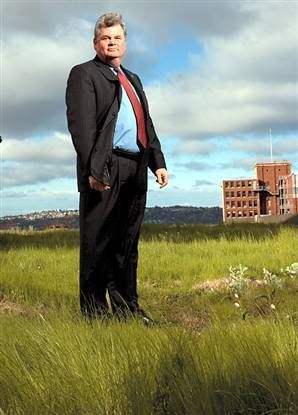
This is the picture that ran in Newsweek with this caption
"Seattle Mayor Greg Nickels, standing on the energy-reducing 'green' roof of city hall, recruited 435 U.S. city leaders to commit to the greenhouse-gas reductions of the Kyoto Protocol"
Read the Article Here
Sunday, April 15, 2007
Earth Month Tip #8, Green Up Your Power
From the City of Seattle
Earth Day April 22, 2007
SEATTLE - Earth Month reminds us that we need to continue to take daily steps to keep our city and our planet healthy and environmentally sustainable. Seattle City Light customers can promote the use of clean, renewable energy by joining the Green Up program.
Green Up allows customers to invest in the development of new renewable energy sources, such as wind power, geothermal and biomass energy. By adding $3 a month to their electricity bills, Green Up participants can take credit for buying enough renewable energy to cover 25 percent of an average residential customer’s usage. A $6 premium covers 50 percent of the average residential usage, and $12 a month equates to 100 percent.
More than 2,500 customers are already participating in Green Up. In 2006, they purchased 34,000 megawatt-hours of renewable energy from the Stateline Wind Project in eastern Washington and Oregon.
Sign up today for Green Up by visiting www.greenupseattle.org or calling (206) 684-8822.
To sweeten the deal, while supplies last, customers who join Green Up or increase their existing participation will receive a 12 ounce bag of organic coffee from local roasters Batdorf and Bronson and a 2 ounce organic chocolate bar from Dagoba Chocolate.
Increasing the use of clean, renewable energy reduces greenhouse gas emissions that can affect climate change. Reducing those emissions is an important initiative for Seattle and the world. For example, scientists believe climate changes are shrinking glaciers in the North Cascades that store the water that allows City Light’s dams to produce electricity. Investing in new renewable energy sources now could help protect Seattle’s existing hydroelectric power supply.
You can make a difference! Start by joining Green Up today and then let others know of your commitment. Tell people where you shop and where you work that climate protection matters. For a list of other great steps to make Seattle and Planet Earth a better place to live, visit the Green Seattle Guide at www.seattle.gov/environment/cag/index.html.
Earth Day April 22, 2007
SEATTLE - Earth Month reminds us that we need to continue to take daily steps to keep our city and our planet healthy and environmentally sustainable. Seattle City Light customers can promote the use of clean, renewable energy by joining the Green Up program.
Green Up allows customers to invest in the development of new renewable energy sources, such as wind power, geothermal and biomass energy. By adding $3 a month to their electricity bills, Green Up participants can take credit for buying enough renewable energy to cover 25 percent of an average residential customer’s usage. A $6 premium covers 50 percent of the average residential usage, and $12 a month equates to 100 percent.
More than 2,500 customers are already participating in Green Up. In 2006, they purchased 34,000 megawatt-hours of renewable energy from the Stateline Wind Project in eastern Washington and Oregon.
Sign up today for Green Up by visiting www.greenupseattle.org or calling (206) 684-8822.
To sweeten the deal, while supplies last, customers who join Green Up or increase their existing participation will receive a 12 ounce bag of organic coffee from local roasters Batdorf and Bronson and a 2 ounce organic chocolate bar from Dagoba Chocolate.
Increasing the use of clean, renewable energy reduces greenhouse gas emissions that can affect climate change. Reducing those emissions is an important initiative for Seattle and the world. For example, scientists believe climate changes are shrinking glaciers in the North Cascades that store the water that allows City Light’s dams to produce electricity. Investing in new renewable energy sources now could help protect Seattle’s existing hydroelectric power supply.
You can make a difference! Start by joining Green Up today and then let others know of your commitment. Tell people where you shop and where you work that climate protection matters. For a list of other great steps to make Seattle and Planet Earth a better place to live, visit the Green Seattle Guide at www.seattle.gov/environment/cag/index.html.
Friday, April 13, 2007
Earth Month Tip #7, Compact Flourescent Lighting
From the City of Seattle
Earth Day April 22, 2007
SEATTLE - Earth Month reminds us that we need to continue to take daily steps to keep our city and our planet healthy and environmentally sustainable. One simple step that can save significant amounts of electricity is choosing the right light bulb.
Compact fluorescent light bulbs use two-thirds to three-fourths less energy than traditional incandescent bulbs and last up to 10 times longer.
While the energy used to run a single light bulb may sound insignificant, the savings from switching to compact fluorescent bulbs adds up. If each of the 330,000 households served by Seattle City Light replaced one ordinary 60 watt light bulb with a 15 watt compact fluorescent bulb in a light fixture that was on four hours a day, 22,000 megawatt-hours of energy would be saved in a year. That’s enough to provide energy for about 2,000 homes for a year.
Compact fluorescent bulbs work best in areas where you keep the lights on for several hours at a time. Outdoor fixtures, floor and table lamps, pendant lights and bare bulbs often used in garages can be great opportunities for using compact fluorescent bulbs.
Read the manufacturer’s recommendations for the best applications and those that are unsuitable for a particular design. For example, some bulbs should not be used in humid conditions or enclosed fixtures. Compact fluorescent bulbs should NOT be used in any fixture controlled by a dimmer switch, unless the bulb package specifically states the bulb is compatible with dimmer switches. Using a non-dimmable bulb could create a fire risk.
While compact fluorescent bulbs last much longer than ordinary bulbs, they do eventually wear out. When that time comes, remember to recycle them. Check out www.takeitbacknetwork.org to find a recycling location near you.
You can make a difference! Start by replacing one incandescent light bulb with a compact fluorescent bulb and then let others know of your commitment. Tell people where you shop and where you work that climate protection matters. For a list of other great steps to make Seattle and Planet Earth a better place to live, visit the Green Seattle Guide at www.seattle.gov/environment/cag/index.html.
Earth Day April 22, 2007
SEATTLE - Earth Month reminds us that we need to continue to take daily steps to keep our city and our planet healthy and environmentally sustainable. One simple step that can save significant amounts of electricity is choosing the right light bulb.
Compact fluorescent light bulbs use two-thirds to three-fourths less energy than traditional incandescent bulbs and last up to 10 times longer.
While the energy used to run a single light bulb may sound insignificant, the savings from switching to compact fluorescent bulbs adds up. If each of the 330,000 households served by Seattle City Light replaced one ordinary 60 watt light bulb with a 15 watt compact fluorescent bulb in a light fixture that was on four hours a day, 22,000 megawatt-hours of energy would be saved in a year. That’s enough to provide energy for about 2,000 homes for a year.
Compact fluorescent bulbs work best in areas where you keep the lights on for several hours at a time. Outdoor fixtures, floor and table lamps, pendant lights and bare bulbs often used in garages can be great opportunities for using compact fluorescent bulbs.
Read the manufacturer’s recommendations for the best applications and those that are unsuitable for a particular design. For example, some bulbs should not be used in humid conditions or enclosed fixtures. Compact fluorescent bulbs should NOT be used in any fixture controlled by a dimmer switch, unless the bulb package specifically states the bulb is compatible with dimmer switches. Using a non-dimmable bulb could create a fire risk.
While compact fluorescent bulbs last much longer than ordinary bulbs, they do eventually wear out. When that time comes, remember to recycle them. Check out www.takeitbacknetwork.org to find a recycling location near you.
You can make a difference! Start by replacing one incandescent light bulb with a compact fluorescent bulb and then let others know of your commitment. Tell people where you shop and where you work that climate protection matters. For a list of other great steps to make Seattle and Planet Earth a better place to live, visit the Green Seattle Guide at www.seattle.gov/environment/cag/index.html.
Thursday, April 12, 2007
Earth Month Tip #6, Conserve Energy
From the City of Seattle
Earth Day April 22, 2007
Seattle - Earth Month reminds us that we need to continue to take daily steps to keep our city and our planet healthy and environmentally sustainable. Seattle City Light offers the following tips to conserve energy.
Stay out of hot water. A hot water tank is the second largest energy user in the home. To reduce the amount of energy it uses, set the tank at 120 degrees Fahrenheit. Take shorter showers, use water-efficient washing machines and wash clothes in cold water. You can save more by running full loads in the dishwasher and the clothes washer.
Turn down, turn off, unplug. Set thermostats at 68 degrees when you’re at home and 55 degrees or lower when you’re away or at night. Turn off lights in empty rooms and unplug electronics such as DVD players and cell phone chargers when not in use.
Keep yourself cozy. Staying warm during the day by dressing in layers and at night by using flannel sheets and a thick comforter on your bed is less expensive than turning up your thermostat.
Circulate the heat. Most of the heat from a baseboard heater will rise to the ceiling and stay there. Use ceiling fans to distribute that heat throughout the room.
Create a heat haven. Plugging leaks around doors, windows, fireplace dampers, attic hatches and wall penetrations will keep the heat in and the cold out. Add insulation to walls, floors, attics and windows.
Refrigerate wisely. Freezers are most efficient when they are packed full. Let hot foods cool before you put them in the refrigerator. Let frozen foods thaw in the refrigerator before cooking.
Dampers make a difference. Make sure to close the damper on your fireplace. Leaving it open while the heat is on is the same as leaving the front door open. It could double your heat bill. Repair a poorly fitting damper and, for an extra layer of protection, install and use glass fireplace doors.
Contact City Light. For more energy and money saving tips, call Seattle City Light’s Conservation Help Line at (206) 684-3000 or visit www.seattle.gov/light/accounts. City Light also can provide technical assistance and even some rebates.
You can make a difference! Start by taking the steps above and then let others know of your commitment. Tell people where you shop and where you work that climate protection matters. For a list of other great steps to make Seattle and Planet Earth a better place to live, visit the Green Seattle Guide at www.seattle.gov/environment/cag/index.html.
Earth Day April 22, 2007
Seattle - Earth Month reminds us that we need to continue to take daily steps to keep our city and our planet healthy and environmentally sustainable. Seattle City Light offers the following tips to conserve energy.
Stay out of hot water. A hot water tank is the second largest energy user in the home. To reduce the amount of energy it uses, set the tank at 120 degrees Fahrenheit. Take shorter showers, use water-efficient washing machines and wash clothes in cold water. You can save more by running full loads in the dishwasher and the clothes washer.
Turn down, turn off, unplug. Set thermostats at 68 degrees when you’re at home and 55 degrees or lower when you’re away or at night. Turn off lights in empty rooms and unplug electronics such as DVD players and cell phone chargers when not in use.
Keep yourself cozy. Staying warm during the day by dressing in layers and at night by using flannel sheets and a thick comforter on your bed is less expensive than turning up your thermostat.
Circulate the heat. Most of the heat from a baseboard heater will rise to the ceiling and stay there. Use ceiling fans to distribute that heat throughout the room.
Create a heat haven. Plugging leaks around doors, windows, fireplace dampers, attic hatches and wall penetrations will keep the heat in and the cold out. Add insulation to walls, floors, attics and windows.
Refrigerate wisely. Freezers are most efficient when they are packed full. Let hot foods cool before you put them in the refrigerator. Let frozen foods thaw in the refrigerator before cooking.
Dampers make a difference. Make sure to close the damper on your fireplace. Leaving it open while the heat is on is the same as leaving the front door open. It could double your heat bill. Repair a poorly fitting damper and, for an extra layer of protection, install and use glass fireplace doors.
Contact City Light. For more energy and money saving tips, call Seattle City Light’s Conservation Help Line at (206) 684-3000 or visit www.seattle.gov/light/accounts. City Light also can provide technical assistance and even some rebates.
You can make a difference! Start by taking the steps above and then let others know of your commitment. Tell people where you shop and where you work that climate protection matters. For a list of other great steps to make Seattle and Planet Earth a better place to live, visit the Green Seattle Guide at www.seattle.gov/environment/cag/index.html.
Earth Month Tip #5 - Reduce Climate Pollution
From the City of Seattle
Earth Day April 22, 2007
Earth Day April 22, 2007
Earth Month helps remind us that we need to continue to take daily steps to keep our city and our planet healthy and environmentally sustainable. The City of Seattle offers the following tips to reduce climate pollution:
Drive less. Reduce your car time by walking, biking, carpooling, taking a bus, carpool and combining errands.
Drive smart. Keep your car tuned and tires properly inflated. Don’t idle when you’re stuck in a line. About 15 seconds is the break even point. Forget the jack rabbit starts. And on the freeway, keep your top speed at about 60 mph.
Be fuel efficient. Not only will you save gas, money and reduce emissions, but driving a fuel-efficient car that gets at least 32 miles per gallon leads to a real reduction in climate pollution. If you drive a diesel vehicle, the more biodiesel you use, the fewer the emissions you produce.
Reduce, reuse and recycle. Nearly every product on the market requires energy to produce, distribute and manage the resulting waste. Choose pre-owned products, products that have recycled content and products that are sold with less packaging.
Use a push or electric mower. Gasoline mowers are one of biggest polluters in the neighborhood. Go manual or electric this season.
Stay out of hot water. A hot water tank is the second largest user of energy in a home. So, set your tank at about 120°F, take shorter showers, use water-efficient washing machines and wash clothes in cold water. You’ll save energy, water and money.
Be a star, buy ENERGY STAR. Look for the ENERGY STAR label, an EPA rating system awarded to only the most energy-efficient appliances, computers, light fixtures and many other electrical conveniences.
Turn down, turn off and unplug. Set thermostats at 68°F when you’re home and 55°F or lower when you’re away or at night. Turn off lights in empty rooms and use compact fluorescent bulbs in place of standard light bulbs. Unplug electronics that aren’t in use. Use a clothes line to dry your wash.
Befriend your utility. Seattle Public Utilities ((206) 684-SAVE), Puget Sound Energy ((800) 562-1482) and Seattle City Light ((206) 684-3800) have great conservation programs and can provide more information, technical assistance and even some rebates.
Shout it out! You can make a difference. Start by taking the steps above and then let others know of your commitment. Tell people where you shop and where you work that climate protection matters.
For a list of other great steps to make Seattle and Planet Earth a better place to live, visit the Green Seattle Guide.
Earth Month Tip #4- Volunteer!
From the City of Seattle
Earth Day April 22, 2007
Earth Day April 22, 2007
Earth Month helps remind us that we need to continue to take daily steps to keep our city and planet healthy and environmentally sustainable. Seattle Public Utilities (SPU) offers the following tips to help you get involved in your community:
Spring Clean is Seattle's premier clean up event and part of Mayor Greg Nickels' Clean and Green Seattle initiative. From April 1 to June 3, Spring Clean provides opportunities for citizens to clean up Seattle's public open spaces of their choice with city support. Find out more on the Seattle Public Utilities’ website, (206) 233-7187
Stencil a Storm Drain Help protect water quality! Sign up to stencil storm drains in your neighborhood with the message, “Dump No Waste: Drains to Stream, Lake or Bay.” Individuals, families, and community organizations and individuals can help. You will receive instructions and the use of a stenciling kit. Call (206) 684-7624 to find out more.
Be a Friend of Recycling. Help others in your apartment building learn how to recycle and receive $100 off your building’s garbage bill. To learn more, contact (206) 684-8717.
Become a Creek Steward. You can make a difference in your watershed by caring for a local creek. Learn about Seattle's creek systems and get involved in sustaining them! Find out more by calling (206) 684-4163.
Join an Advisory Council. Seattle Public Utilities encourages residents to serve on one of the citizen advisory committees that help keep SPU in touch with the community's viewpoints on solid waste, water and drainage issues. To find out more, call (206) 684-7624
Join the Friends of Cedar River Watershed, a private, non-profit organization incorporated in 1996 and dedicated to the protection and restoration of the Cedar River Watershed, an ecological preserve that is source of drinking water to more than a million greater Seattle area residents. Learn more at www.cedarriver.org
Adopt-A-Street! Help keep your community clean! Call (206) 684-7647 to adopt a street in your neighborhood.
Apply for an Aquatic Habitat Matching Grant. Seattle Public Utilities provides matching grants for individuals or groups to help improve Seattle's aquatic habitat. Awards amounts begin at $2,000 per project, with $300,000 in total awards available. Projects require a one-to-one match. Proposals are due April 27. Find out more at the Aquatic Habitat Matching Grant Program website.
For a list of other great steps to make Seattle and Planet Earth a better place to live, visit the Green Seattle Guide.
Earth Month Tip #3 – Prevent Water Pollution
From the City of Seattle
Earth Day April 22, 2007
Earth Day April 22, 2007
Earth Month serves to remind us that we need to continue to take daily steps to keep our city and our planet healthy and environmentally sustainable. Seattle Public Utilities offers the following tips to keep our waterways clean:
Go Natural! Use lawn and garden chemicals sparingly or use organic alternatives. Whatever you put on your lawn could find its way to a stream. Northwest Natural Yard Days, April 15 – May 15, offers deep discounts on products for environmentally-friendly gardening. Don't miss out! For a list of participating retailers, visit the Northwest Yard Days website or call (206) 633-0224.
Go Native! When gardening, choose native plants that require fewer chemicals and less watering. For free native plant advice, call the Natural Lawn and Garden Hotline at (206) 633-0224.
Don't Dump anything into storm drains. Storm drains often drain directly to local lakes and streams.
Report Water Pollution! Call the Water Quality Hotline at (206) 684-7587 if you see oil sheens, soap or other pollutants in local waterways.
Volunteer to stencil storm drains in your neighborhood with the message, “Dump No Waste: Drains to Stream, Lake or Bay,” by calling (206) 684-7624.
Salmon-Friendly Car Wash! Did you know that soap is highly toxic to fish? Take your car to a car wash that recycles its water. Or, wash your car on the lawn or gravel. Use soaps without phosphates.
Keep Your Car Well-maintained. Fix oil leaks and recycle oil and other car fluids.
Scoop Your Poop! Always carry a plastic bag with you when walking your dog and place the waste in the trash. Dispose of cat litter in a garbage bag as well.
Be a Creek Steward! Volunteer to help care for a section of Seattle’s urban creeks. Find out more at Be a Creek Steward website.
Prevent Septic Leaks by keeping your system maintained.
Check your Heating Oil Tank! Every year, heating oil from leaking tanks finds its way into our local waterways. Insure your heating oil tank for FREE! For more information, visit the Pollution Liability Insurance Agency.
Sweep. Use a broom instead of a hose when cleaning driveways and sidewalks.
For a list of other great steps to make Seattle and Planet Earth a better place to live, visit the Green Seattle Guide
Subscribe to:
Posts (Atom)